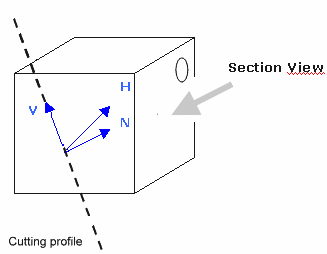
Axis Orientation
Orientation, Position, and CoordinateThe Sensor Fusion and Tracking Toolbox™ enables you to track orientation, position, pose, and trajectory of aplatform. A platform refers generally to any object you want totrack. OrientationOrientation is defined by angular displacement. Orientationcan be described in terms of point or frame rotation. In point rotation, thecoordinate system is static and the point moves. In frame rotation, the point isstatic and the coordinate system moves. For a given axis and angle of rotation,point rotation and frame rotation define equivalent angular displacement but inopposite directions.Sensor Fusion and Tracking Toolbox defaults to frame rotation.
For example: With an orientation angle of 0, the groove is cut in the machine's Y direction. With an orientation angle of 90, the groove is cut in the machine's X direction. This option only applies if the machine tool starts at the singularity (where the machine tool's Z-axis is aligned with the setup's Z-axis).
Orientation is defined as the frame rotation that takes the parent frame to thechild frame. The choice of parent frame depends on the problem space. For example,manipulating sensor frames is necessary to align various axes of independentsensors.
Tracking the body frame is often used for stabilization tasks. The groundreference frame is useful for tracking multiple independent platforms and locatingplatforms in an absolute sense.Sensor Fusion and Tracking Toolbox primarily supports the NED (north-east-down) coordinate frame. You canalso use the ENU (east-north-up) coordinate frame in many features. R ( ψ, θ, ϕ ) = R x ( ψ ) R y ( θ ) R z ( ϕ ) = cos ψ cos θ sin ψ cos θ − sin θ cos ψ sin θ sin ϕ − sin ψ cos ϕ sin ψ sin θ sin ϕ + cos ψ cos ϕ cos θ sin ϕ cos ψ sin θ cos ϕ + sin ψ cos ϕ sin ψ sin θ sin ϕ + cos ψ cos ϕ cos θ cos ϕ For features that support frame-based processing, Sensor Fusion and Tracking Toolbox provides coordinates as an N-by-3 matrix, whereN is the number of samples in time and the three columnscorrespond to the x-, y-, andz-axes. The following calculation rotates a parent frame to achild frame. % Euler angles defining orientation of local axesyaw = 20;pitch = 5;roll = 10;% Create orientation matrix from Euler angles using quaternion classq = quaternion(yaw pitch roll, 'eulerd', 'zyx', 'frame');myRotationMatrix = rotmat(q, 'frame');Seefor moreinformation on using quaternions in Sensor Fusion and Tracking Toolbox.
PositionPosition is defined as the translational distance from aparent frame origin to a child frame origin. For example, take the local NEDcoordinate system as the parent frame.
In the NED coordinate system. Property/FieldDescriptionUnitsCoordinate FramePositionCurrent position of platform in scenariomNED or ENUVelocityCurrent velocity of platform in scenariom/sNED or ENUAccelerationCurrent acceleration of platform in scenariom/s 2NED or ENUOrientationCurrent orientation of platform in scenariounit quaternion / orientation matrixN/AAngular velocityCurrent angular velocity of platform in scenariorad/sNED or ENUTrajectoryTrajectory defines how pose changes over time. To generateground-truth trajectories in Sensor Fusion and Tracking Toolbox, use. To simulate tracking multiple platforms, use.
You can choose from five orientations: Global, Local, Normal, View, and Gimbal. Working in any of these coordinate systems gives you absolute control of how your object lives in 3D space. Philips spc110nc webcam drivers for mac. Depending on how you’d like to transform your object, one orientation may be more appropriate than the others. Blender also gives you the ability to create custom orientations. After you create a custom orientation, it also becomes available on the Transform Orientation menu.This list describes details of the five possible orientations:.Global: You see this orientation of Blender’s base grid in the 3D View. In many ways, the Global orientation is the primary orientation to which everything else relates, and it’s the base coordinate system described.
The Z-axis, marked in blue, runs vertically in the space. The Y-axis is marked in green, moving along the front-to-back line, and the X-axis is in red, along the side-to-side line. The origin is located directly at the center of the grid.Local: In addition to the Global orientation, each 3D object in Blender has a local coordinate system. The base of this system isn’t the same as the Global coordinate system’s base. Instead, this coordinate system is relative to the center point, or origin, of your object.The object origin is represented by the orange dot that’s usually located at the center of your 3D object. By default, when you first add a new object in Blender, its Local coordinate system of the object is aligned to the Global axis, but after you start moving your object around, its Local coordinate system can differ greatly from the Global orientation.Normal: The Normal orientation is a set of axes that’s perpendicular to some arbitrary plane. When working with just objects, this description doesn’t really apply, so the Normal orientation is exactly the same as the Local orientation.When you begin editing meshes, though, Normal orientation makes more sense because you have normals (imaginary lines that extend perpendicular to the surface of a triangle or plane) to work with.
Blender also uses the Normal orientation for the local coordinate system of bones when working with Armatures for animation. A nice way to think about the Normal orientation is the “more local than local” orientation.Gimbal: When you rotate an object about its X, Y, and Z axes, the angles about those axes are known as Euler (pronounced like oiler) angles.Unfortunately, a side effect of using Euler angles is that you have the possibility of running into gimbal lock. You run into this problem when one of your rotation axes matches another one. For example, if you rotate your object 90 degrees about its X-axis, then rotating around its Y-axis is the same as rotating about its Z-axis; mathematically speaking, they’re locked together, which can be a problem, especially when animating. This orientation mode in Blender helps you visualize where the axes are, so you can avoid gimbal lock.View: The View orientation appears relative to how you’re looking at the 3D View. Regardless of how you move around in a scene, you’re always looking down the Z-axis of the View coordinate system. The Y-axis is always vertical, and the X-axis is always horizontal in this orientation.
All these coordinate system explanations can be (please forgive the pun) disorienting. An easy way to visualize this concept is to imagine that your body represents the Global coordinate system, and a book is a 3D object oriented in space. If you hold the book out in front of you and straighten your arms, you move the book away from you. It’s moving in the positive Y direction, both globally and locally.
::AuthorMessageMowdiggerRegularJoined: 21 Mar 2012Posts: 94Posted: Mon Jan 06, 2014 3:15 pm Post subject: Snowblower for Cub Cadet 149I need some advice on cub cadet snow blowers. Cub cadet 149 backhoe. Do they work good on the front of the older cub model 149?
Now, if you twist the book to the right a few degrees and do the same thing, it still moves in the positive Y direction globally. However, in its local orientation, the book is moving in both a positive Y direction and a negative X direction. To move it in just the positive local Y direction, you move the book in the direction in which its spine is pointing.To relate this concept to the View orientation, assume that your eyes are the View axis. If you look straight ahead and move the book up and down, you’re translating it along the View orientation’s Y-axis. Gimbal orientation would be if you rotate the book 90 degrees toward you, rotating about its X-axis. Then it’s Y and Z axes are locked together. For a clear reference, the 3D manipulator shows the difference between the coordinate systems.